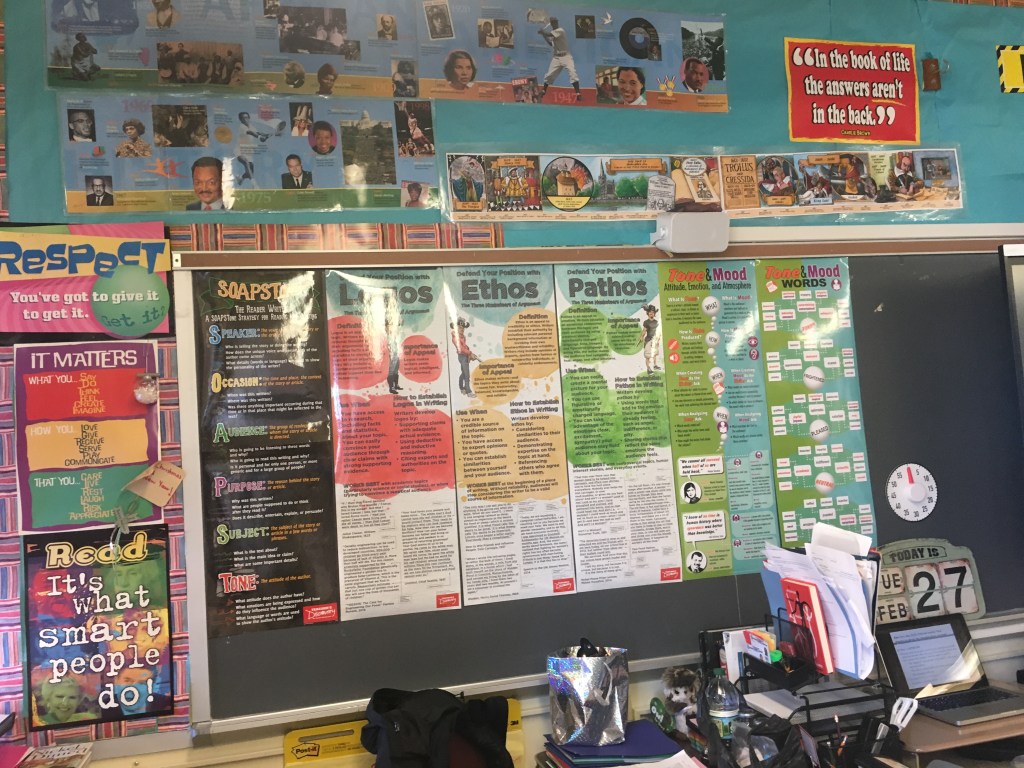
Course Description: The AP Language and Composition course is designed for students to understand the role of the audience, authorial purpose, and rhetorical style and technique through a study of primarily nonfiction and news media. In addition to the required texts, the teacher will provide a chronological sequence of primary source documents from various publications and Internet sources. Students will learn various strategies to evaluate the credibility and relevance of these sources. The first half of the course will be devoted primarily to historical literature while the second will focus on nonfiction. Writing in this course will be extensively analytical, expository, or persuasive, and occasionally creative. In addition to the daily responses to readings and required essays, students must also complete extensive revisions to demonstrate their mastery of the rhetorical, expository, and analytical techniques studied. Finally, students must also read reputable periodicals and listen to political commentary on news media to keep abreast with current political and social issues. They will have to keep a weekly journal, commenting on these articles and shows, using précis paragraph organization. Student/teacher writing conferences and peer editing will be held regularly within and outside of the class to ensure that students’ composition reflect sensitivity to audience, purpose, and appropriate textual details.
Course Overview: The AP Language and Composition course will touch on a variety of genres but will emphasize nonfiction. The course will introduce students to rhetorical devices used in nonfiction, particularly speeches, essays, and autobiography. Students will compare and contrast the effects of rhetorical style and techniques used in each genre, their effects on the reader, as well as the meaning and purpose of the text. Students will write expository and argument essays and daily responses to the readings. They will use expository techniques of description, narration, illustration, comparison and contrast, definition, classification, process analysis, cause and effect, and argumentation, and when possible, they will also employ the aesthetic proofs. They will apply OPTIC strategies to examine political cartoons, graphs, charts, and other visuals.
Expectations:
· Students will complete logs with daily readings.
· Students will complete weekend journals about news on political or social issues.
· Students will write timed in-class essays, two to three times a week.
· Students will complete revisions of in-class writings after writing conferences two to three times a week.
· Students will complete AP style exams at the end of each unit.
· Students will learn to identify rhetoric, including tone, diction, syntax, etc.
· Students will become more sensitive to language and word use in a text through close readings and analysis.
· Students will know how to analyze and evaluate the way in which language and rhetorical devices convey the larger meaning of a text through close readings and prose analysis.
· Students will learn how to evaluate an argument.
· Students will learn how to construct arguments of their own.
· Students will evaluate their own growth through portfolio development.
· Students will participate in small groups and/or class discussions about the text.
· Students will conduct themselves maturely, being respectful, punctual, and regular in attendance.
Units include but are not limited to:
Unit 1—Is College Worth the Cost?
Students will study a variety of articles and essays. The emphasis will be on diction, tone, figures of speech, and other rhetorical techniques common in prose. They will complete daily responses that may be a personal reflection, an analytical essay, and/or guided questions, culminating in an argument on whether college is worth the cost.
Unit 2—Speeches and Essays
In the most extensive and the final unit before the exam, students will read various speeches and essays, touching on themes and topics we have discussed before, such as the coming of identity, language, the writing process, etc. They will explore closely different forms of expository writing techniques, such as narration, description, argumentation, etc. Their daily writing will reflect the types of expository techniques we have studied.
Unit 3—Transcendentalism
In a continued study of prose analysis, students will study the philosophy of Transcendentalism, focusing on the major themes such as individuality and independence, the role of nature, and the primacy of individual conscience. They will examine how tone and diction contribute to the meaning of the essays, how syntax lends itself to tone, and how biblical, classical, and historical allusions also contribute to the overall meaning of the essays. Students will also conduct research on the authors’ background to examine how their backgrounds contribute to the major themes of their work.
Unit 4—The Autobiography
Students will read the autobiography as well as several essays and supplemental texts, examining the authors’ use of language, diction, and syntax. Students will further define and understand the coming of age experience. Students will write daily responses on the readings, commenting on how each episode in Malcolm X’s life transcends the experience of W. E. B. Dubois’s notion of the “vast veil” and Paul Laurence Dunbar’s idea of a “mask.”
Unit 5—The Expose, Nicked and Dimed and Fast Food Nation
Students will read Fast Food Nation and/or Nickeled and Dimed as an introduction to book-length investigative journalism. In doing so, they will learn how an everyday topic can be read as being much more than everyday. Students will read a number of supplementary articles, and conduct a media study, both guided and independent of class, into the matter of labor and consumption when it comes to the American Dream.
Unit 6—The Senior Thesis Project
The thesis project will be a culminating assignment in which students choose to explore an issue in-depth. Students may draw from journals to find issues that they garnered from news commentary. Students must use the MLA format, and projects should include a works cited page.
Final Project: Write a thesis paper in which you discuss a modern topic that reflects an issue we have studied this semester or one that arose in keeping your journal. Find contemporary sources that expound on the topic you have chosen. Your sources must be varied, including articles, videos, books, etc. A thesis proposal must be submitted and approved before you proceed with the project.
Required Materials:
|
Recommended Materials:
|
 Eduspiration